
Step off the train at Camucia-Cortona on a July afternoon and the first thing that hits you is not the heat. It is the smell of aglione. The giant Val di Chiana garlic, sweeter and quieter than the regular kind, gets cooked into Cortona’s tomato sauce and spread thick over hand-rolled pici, and it perfumes the platform before you have even seen the town. Cortona itself is a sand-coloured wedge of stone three kilometres uphill, walled, and visible from anywhere in the valley. You smell the lunch before you see the town. That is the right introduction to a place where the food and the geography are working as one organism.
Frances Mayes wrote her 1996 memoir Under the Tuscan Sun about restoring an actual villa called Bramasole on the hillside just north of these walls. The 2003 film, which was shot here in the historic centre, is a separate, looser thing. The villa in the movie is not Bramasole. The fountain in Piazza Signorelli is a fibreglass prop. The Bramasole that Mayes still owns and lives in for half the year is on a private road and you cannot go inside. None of that matters. The town the book is about is the actual town, and you can walk every street she names.
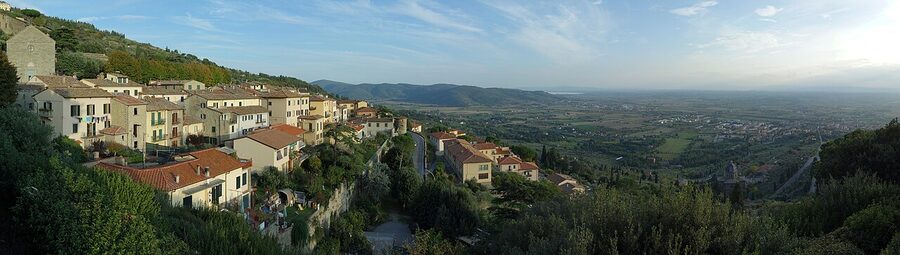
This is a guide for two readers. The Mayes fan who wants to find Bramasole and walk the streets of the book. And the regular traveller who has heard Cortona is the prettiest hill town in southern Tuscany and wants to know how to spend a couple of days there without overpaying or driving down a flight of stone stairs. Both should read both halves. The book is the lens. The town is excellent on its own.
In This Article
- Before you go: the practical bit
- Bramasole: where the book actually happens
- Piazza della Repubblica and Piazza Signorelli
- MAEC and the Etruscans nobody comes here for
- The walk up to Santa Margherita and the Fortezza
- Eremo le Celle: the walk to the hermitage
- Where to eat, and what to eat
- The wine you have not heard of: Cortona DOC
- Day trips: Pienza, Montepulciano, and Lake Trasimeno
- Where to stay
- How long to stay, and when
- What to read on the train up
- The thing nobody tells you
Before you go: the practical bit
Cortona is in the very southeast corner of Tuscany, on the border with Umbria, 100km southeast of Florence and 200km north of Rome. The historic centre is small, walled, and almost entirely pedestrian. You will be on your feet on stone, and the only flat street in the upper town is Via Nazionale, known locally as the Rugapiana. Everything else slopes.
From Florence, take a regional train from Santa Maria Novella to Camucia-Cortona. About 90 minutes, around 12 euros one-way. From Camucia station, the LFI bus runs up the hill to Piazza Garibaldi every 30 to 60 minutes; tickets are 1.50 euros from the station newsstand or 2.50 onboard. The walk up takes about 45 minutes if you fancy it, and it is steep at the end.
From Rome, the fastest route is a Frecciarossa to Florence and back down on the regional, which takes around three and a half hours total. Cheaper and slower: the regional via Terontola-Cortona changes at Chiusi and runs about four hours.
From Perugia, an hour by direct regional, around 6 euros. This is the underrated approach. Perugia is gorgeous and worth a night either side.
If you are renting a car (and for the wider Tuscany trip you should), exit the A1 at Betolle-Valdichiana. Park at one of the lots along the wall (Parcheggio Spirito Santo, Parcheggio dello Stadio). Do not drive into the upper town. The streets are ZTL-restricted and a few of them are flights of stairs. One blogger I read followed Siri into one. Siri is wrong about Cortona.
If you only have one travel day to read on the plane, read the first six chapters of Mayes’s book. That covers the buying of Bramasole, the arrival, the first walks through town, and the early markets. The cookbook chapters and renovation diaries are good but not necessary for orientation.
Bramasole: where the book actually happens
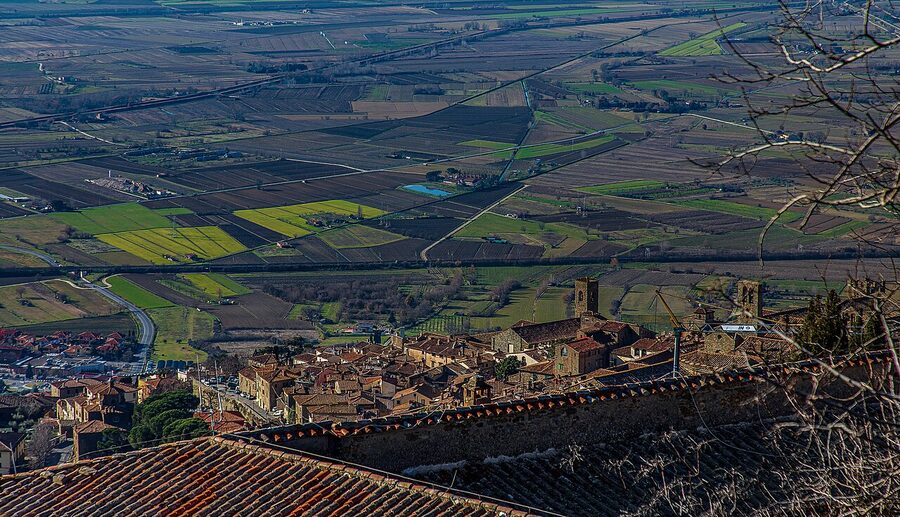
Frances Mayes and her husband Ed bought Bramasole in 1990, fully overgrown, and have lived there for at least six months a year ever since. The villa’s name translates roughly as “yearning for sun,” which Mayes explains in chapter one: south-facing, on a sun-soaked slope, with the Val di Chiana opening below and Lake Trasimeno glinting in the distance.
You can walk past it. You cannot go in. The villa sits behind a gate on a residential lane, and locals are courteous about the steady stream of fans walking by, but it is still someone’s house. Take your photo from the road, do not climb the gate, and move on. The walk up from town takes 15 to 20 minutes from Piazza Garibaldi up Via Severini, and the views over the valley going up are arguably better than the villa itself.
One thing the book does not tell you: the film of Under the Tuscan Sun was not shot at Bramasole. The film’s villa is Villa Laura, in Campaccio, a few kilometres outside town, and it was empty and overgrown when the production found it. After the film became a hit, the owners turned the 17th-century estate into a weekly rental. Bookings are at Villa Laura. It sleeps up to 20 and rents only by the week, with low-season rates from around 21,000 euros and high-season around 27,500. That is a wedding-party number, not a couple-of-nights number.
Piazza della Repubblica and Piazza Signorelli
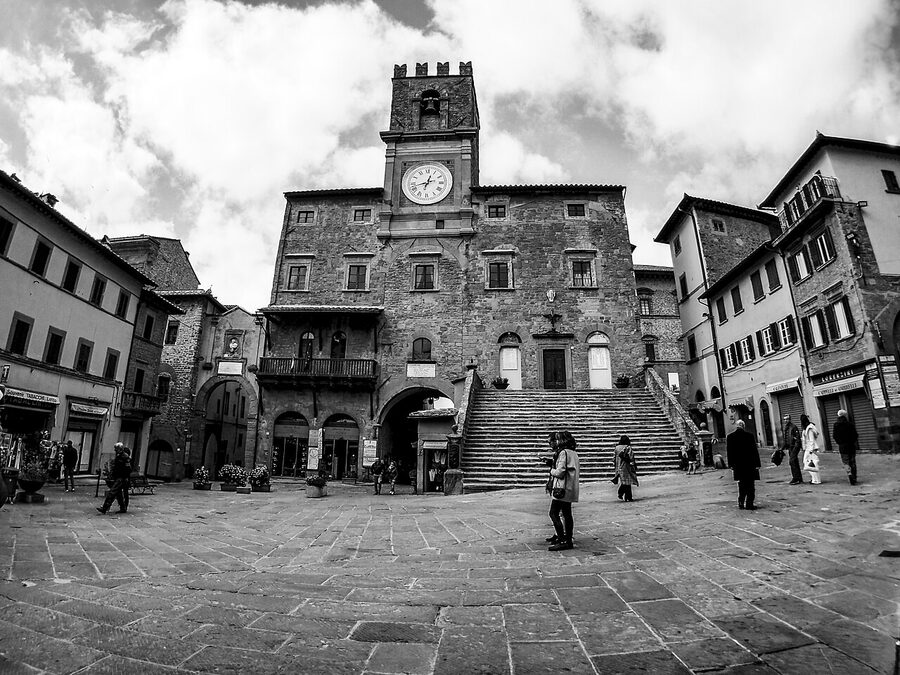
The two main squares are essentially one continuous space, joined at the corner where Via Nazionale meets the steps of the Palazzo Comunale. They are where you arrive, where you eat, where you read, where you sit at 6.30pm with a Negroni and watch everyone else do the same. You will end up in one of them every day you are here, probably twice.
Piazza della Repubblica is the bigger one, dominated by the staircase up to the medieval Palazzo Comunale. Piazza Signorelli is round the corner, smaller and quieter, with the neoclassical Teatro Signorelli on one side and the Palazzo Casali on the other. Casali is where the MAEC museum lives (more on that in a minute).
This is where the film of Under the Tuscan Sun built its prop fountain. There is no actual fountain in Piazza Signorelli, and there never was; the film team built an eight-by-eight metre fibreglass and foam Baroque fountain with a naked Neptune on top, which the locals were fairly cross about at the time. It is gone, of course. There is a real fountain in Cortona’s small Parterre park near Piazza Garibaldi, and that is where Diane Lane jumps in. Worth a polite laugh as you stand in the empty Piazza Signorelli for a moment imagining a foam Neptune that nobody asked for.
Best aperitivo seats: Caffe Signorelli on Piazza Signorelli for the slow stage-set feel, Tuscher for cocktails that are taken seriously, Sotto Voce for natural wines. A glass of local Cortona DOC Syrah runs around 6 euros; a Negroni 8 to 10. Service is leisurely. That is the point.
MAEC and the Etruscans nobody comes here for
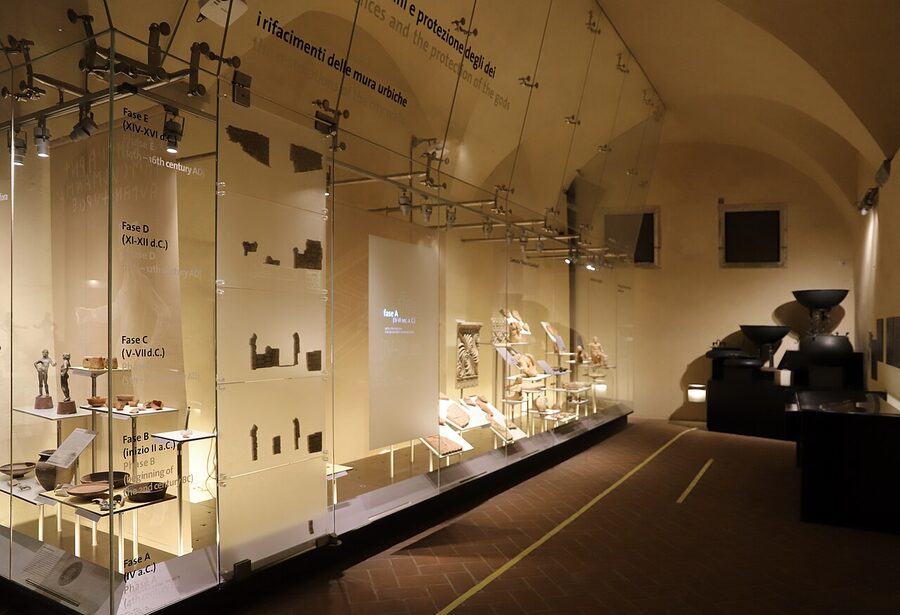
Cortona is older than Rome. The Etruscans founded a city here in the 7th century BC and made it one of the twelve members of their northern league. Most of the people who come for the Mayes book skip the MAEC entirely, which is a small shame because the collection is genuinely good and the building is the prettiest Renaissance palazzo in town.
The thing to see is the bronze oil-lamp chandelier from around 400 BC. It is the size of a small bicycle wheel, ringed with relief figures of beasts and demons, and was found in a field outside Cortona in 1840. It would be the prize of any modern home-design store. There is also a respectable Egyptian collection (don’t ask) and a room of paintings by Gino Severini, who was born in Cortona in 1883 and went on to be one of the founders of Italian Futurism in Paris.
Combined ticket with the Diocesano gets you both museums for 13 euros. The Diocesano is across town near the Duomo, smaller, and home to Fra Angelico’s Annunciation and Luca Signorelli’s Deposition. Signorelli was a Cortona local; he modelled the dead Christ on his own son, who had just died in the plague. The painting is unsettlingly raw. Worth the half hour to see it.
The walk up to Santa Margherita and the Fortezza
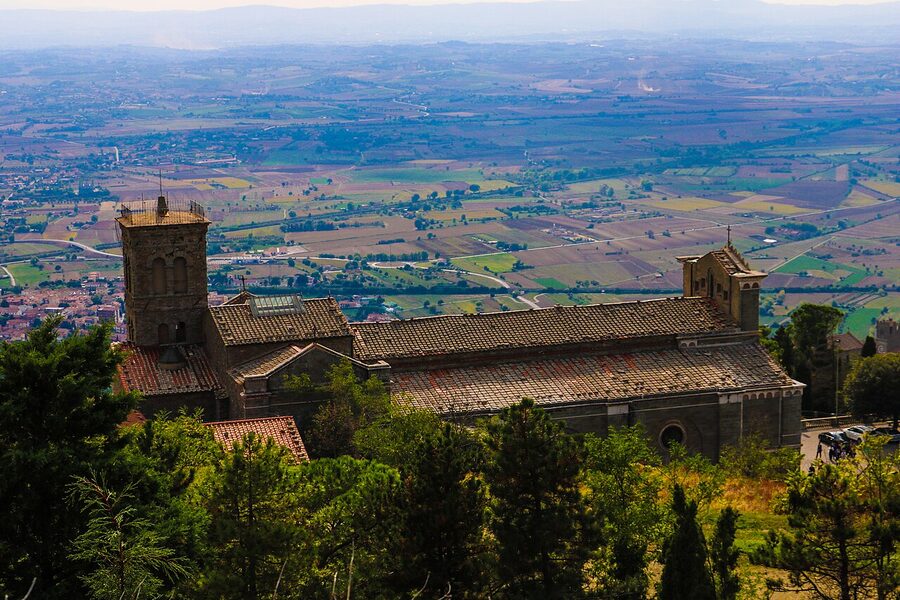
From the twin squares, every street eventually points up. The walk to the Basilica of Santa Margherita is the one to commit to. It is steep, the stone is uneven, and you will be sweating by the time you arrive, which is why nearly every guidebook calls it earning your badge. They are not wrong.
The path is lined with the Stations of the Cross in mosaic, designed by Cortona’s own Gino Severini in 1947. They are easy to miss because you are mostly looking at your feet. Look up. The fourteen panels are in vivid Futurist style and were Severini’s gift to his hometown after a lifetime in Paris.
The basilica at the top holds Santa Margherita herself, in a glass tomb behind the altar. She was a 13th-century follower of St Francis, born in Laviano nearby. Her remains are visible. Some people find this powerful, some find it macabre; I find it the kind of detail you remember.
From the basilica, keep climbing 10 more minutes to the Fortezza del Girifalco, the Medici fortress crowning the very top of the hill. Cosimo de’ Medici built it in 1556 to keep his hold on Cortona’s revenue. The vaulted galleries inside are good for cool air on a hot day, and the wine bar in the courtyard is a small surprise; you can sit on a bench above the entire Val di Chiana with a glass of Cortona DOC for around 7 euros and stare at Lake Trasimeno glinting on the horizon. This is the sit-down view of the whole region. Allow an hour.
Coming back down, take the longer path past the Convent of San Francesco and the small church of San Niccolò. Less steep, more shaded.
Eremo le Celle: the walk to the hermitage
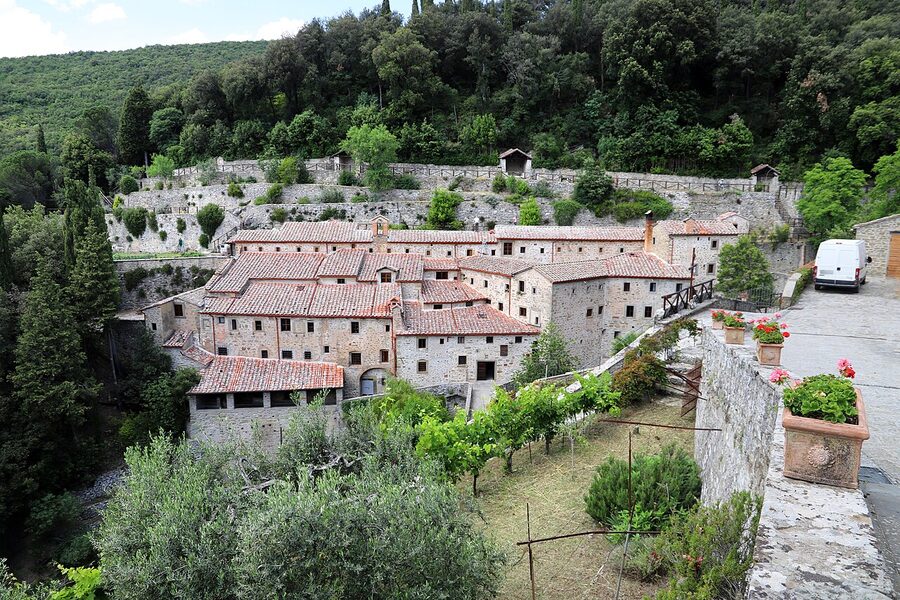
St Francis of Assisi retreated to Cortona in 1211, then again in 1226 just before his death, and lived in a stone cell on this hillside about 3km north of town. His follower Brother Elias, who was actually born in Cortona, founded the small community here that became Eremo le Celle. There is still an active religious community on the site today, mostly Capuchin friars, and they let visitors in for free during daylight hours.
The walk out is the point. Follow Via Severini and then Via dell’Eremo through olive groves and chestnut woods, past stone walls and small farms and the occasional barking dog. There is a stream running through the property at the bottom of a small canyon, and stone bridges and a tiny chapel in the middle of it all. The whole effect is quiet in a way the town deliberately is not. Mayes mentions Le Celle in the book; the description still holds.
Birdsong, water, occasional bell. Allow two and a half hours including the walk both ways. Take a cap; the climb back is in full sun. You can also drive, but the woods are most of what you came for.
Where to eat, and what to eat
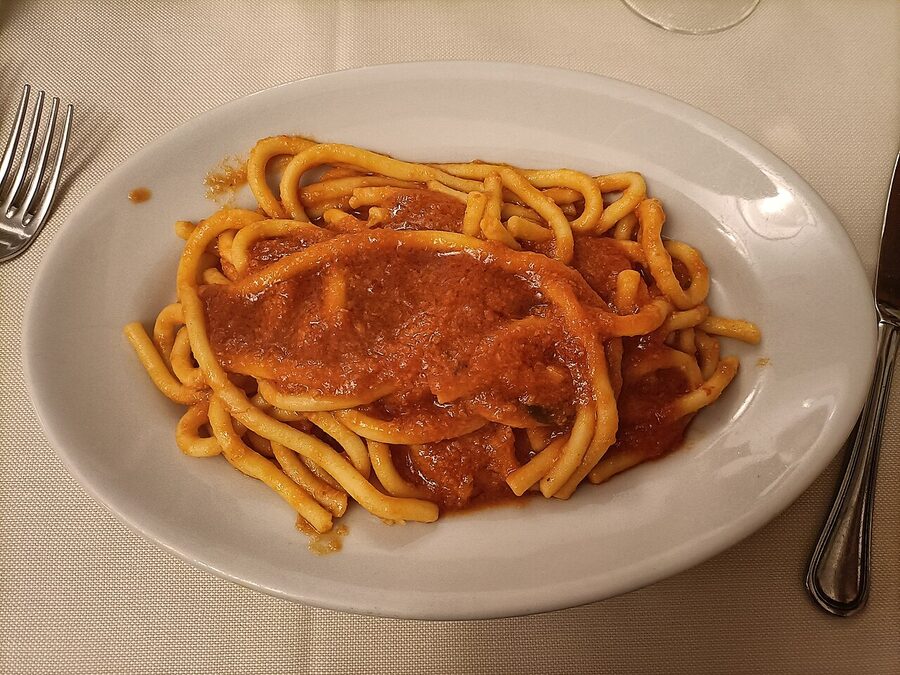
Cortona is one of those places where you eat better than you expect to, partly because of the Chianina cattle in the valley below town and partly because the restaurants have not yet been ruined by the volume of summer tourism. There are maybe 20 restaurants worth eating in. None of them turn tables. You will need a reservation in May, September, and October.
Order one of these in your first 24 hours: pici all’aglione (the local hand-rolled pasta with sweet garlic and tomato), bistecca alla fiorentina (the Chianina T-bone, simply grilled, usually for two), tagliata di manzo (sliced beef with rosemary and pepper), or pici al fumo (smoky bacon-tomato, the Cortonese specialty).
La Bucaccia. Stone-walled cellar restaurant on Via Ghibellina. Tuscan classics turned creative. The Chianina ravioli with truffle is the dish to order. Romano, the owner, will be peacocking around the room and either charm or annoy you, sometimes both in the same meal. Around 50 to 70 euros for two with wine. Reserve a week ahead in high season.
Trattoria La Grotta. Tucked off Piazza della Repubblica, built into stone vaults; the walls are part of the mood. Pici and tagliata di manzo are what to order. Service is quietly attentive. About 45 to 60 euros for two with wine. Closed Tuesdays.
Trattoria Dardano. Casual, large, and a fall-back when nowhere else has space. Excellent house pastas and house-made sausage. Try the tortellini alla Norcina, which Dardano is the only place in town to do well. Cheaper than the others, around 35 to 45 euros for two.
Osteria del Teatro. Candlelit rooms, more refined cooking, behind Teatro Signorelli. Chef Emiliano Rossi pairs heavily with Cortona’s own Syrah-based DOC reds. Around 55 to 75 euros for two. Book direct.
Skip Caffe Signorelli for full meals, fine for an aperitivo and not much else. Skip any place on the main drag with a printed photo menu in five languages. Cortona is small; the wrong restaurants are obvious.
The wine you have not heard of: Cortona DOC
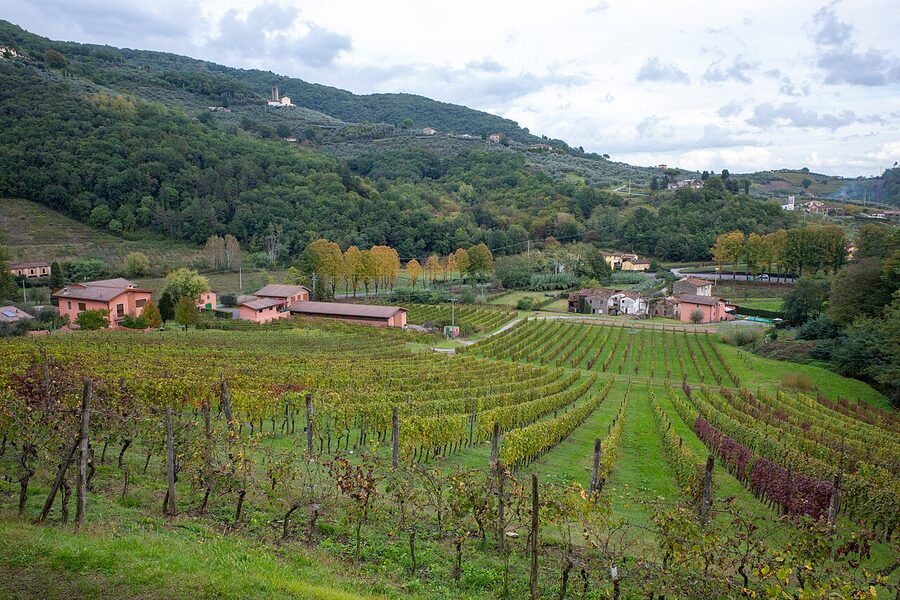
Most of Tuscany makes wine from Sangiovese: Chianti, Brunello di Montalcino, Vino Nobile. Cortona, oddly, does not. The Cortona DOC, established in 1999, is built around Syrah, planted heavily in the valley by enterprising local producers in the 1980s and 90s on the theory that the southeast-facing slopes and the dry summers would suit it. They were right. Cortona Syrah is darker and more peppery than what Sangiovese produces, and it pairs aggressively well with Chianina beef.
You can sample at Molesini on Piazza della Repubblica, the venerable wine shop in town (worth visiting just for the building, which dates to the 1500s). For a deeper dive, the wineries run tastings; Tenimenti d’Alessandro is 10 minutes by car and the most consistent estate. Stefano Amerighi is the cult producer; visits by appointment, arranged through wine concierges or local guides. Tastings are typically 25 to 40 euros per person and worth half a day.
If you do not want to drive, book a wine tour from town. Viator, GetYourGuide, and Klook all run half-day group tastings out of Cortona for around 80 to 130 euros per person, transport included. Compare them on the day you arrive and pick whichever has the producer you actually want to visit.
Day trips: Pienza, Montepulciano, and Lake Trasimeno
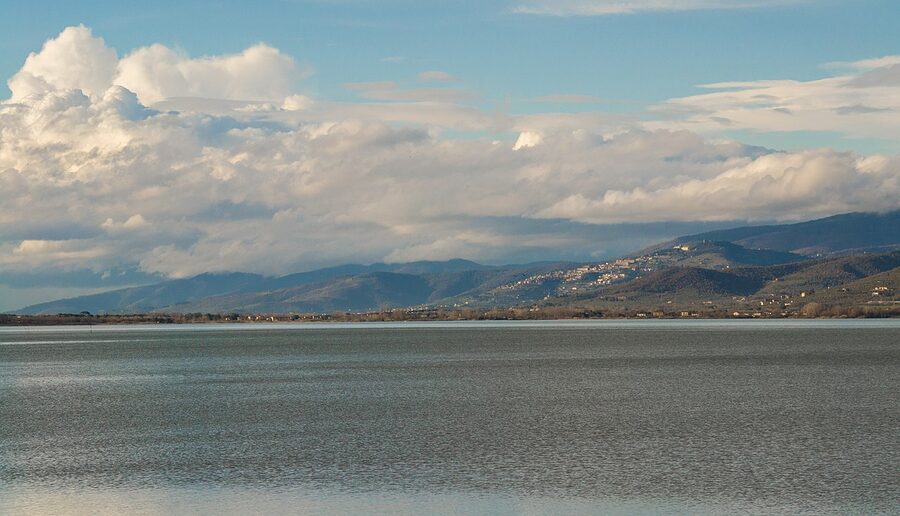
If you have three or four days, base in Cortona and drive out. Two of the great Tuscan day trips and one of the great Umbrian ones are within an hour.
Montepulciano is 35 minutes west by car. Wine town, hilltop, famous for Vino Nobile. The walk up the main street to Piazza Grande at the top is the standard agenda; stop into one of the cellars on the way (most are old palazzo basements opened to visitors) for a tasting. Half a day plus lunch.
Pienza is 50 minutes from Cortona, the Renaissance ideal city built by Pope Pius II in the 1460s, now famous for sheep’s-milk pecorino cheese. It is small enough to see in two hours but the Val d’Orcia drive in and out is the real reason to go. Combine with Montepulciano on a single day.
Lake Trasimeno is the easy one. 20 minutes by car to Passignano, a low-key lakeside town with cafes, ferries to the islands, and a narrow beach. Hannibal beat the Romans here in 217 BC; there is a small archaeological trail along the south shore if you care about that. If you do not, swim or sit at a cafe and watch fishermen come in with eels.
Further afield: Arezzo (40 minutes), where Piero della Francesca’s Legend of the True Cross fresco cycle is the reason to visit; Perugia (45 minutes), Umbria’s lively university capital; Assisi (an hour) for the Basilica of St Francis. Siena is an hour and 15 minutes, doable as a long day, but Siena deserves an overnight on its own.
Where to stay
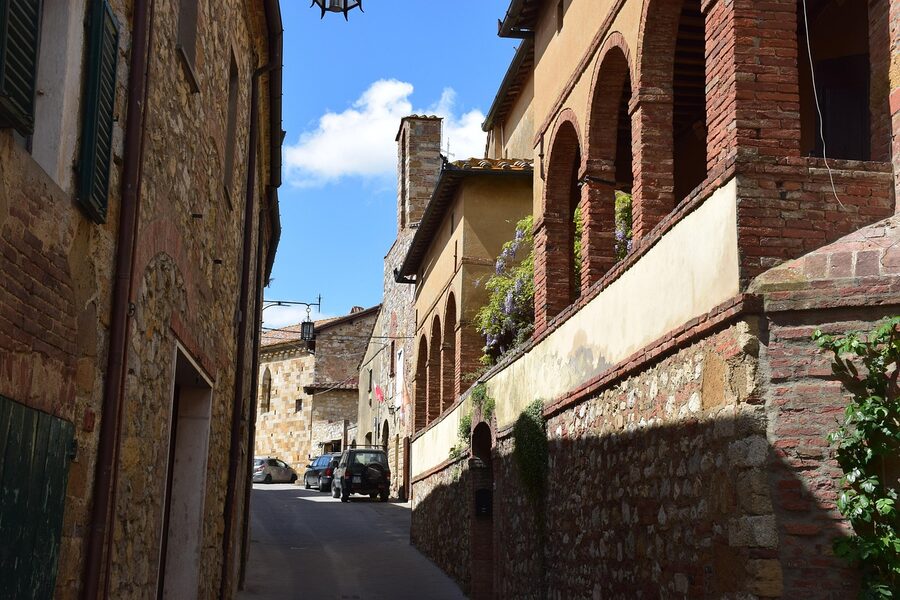
You have three reasonable options: a hotel inside the walls, a country agriturismo in the surrounding hills, or an apartment let in town. I would push you toward the first if it is your first visit.
Monastero di Cortona Hotel & Spa. Inside the walls, in a converted 13th-century monastery, adults-only, four-star with a small spa and pool. The most-mentioned hotel in Cortona for a reason; the staff is the genuine standout. Around 280 to 600 euros a night depending on season. Check rates on Booking.com.
Hotel Italia. A 15th-century palace just off the main square, atmospheric, three-star, the right answer if you want to be in town and you are not splashing out. About 100 to 140 euros a night. Booking.com.
Hotel San Michele. Old-world charm in a converted palazzo on Via Guelfa. 90 to 150 euros a night. Walk-up to your room is on the steeper side; ask for a low floor if your knees complain. Booking.com.
Villa di Piazzano. Just below the walls, a five-star villa hotel with manicured grounds and a pool. The closest thing to the Bramasole experience without having to renovate anything. 400 to 800 euros a night. Booking.com.
Relais Il Falconiere. Country option, 10 minutes drive out of town, Michelin-starred restaurant attached, the local indulgence. They also run cooking classes that are some of the best in this corner of Tuscany. 350 to 750 euros. Booking.com.
Compare the in-town options on Agoda as well; rates can vary by 15 to 20 percent between platforms in low season.
How long to stay, and when
One night is enough to walk the town and eat well. Two nights is the right number for most people; you cover Piazza della Repubblica, Bramasole, the Santa Margherita climb, MAEC, one good lunch and one good dinner. Three nights gives you a wine tasting and a day trip. Four nights is when you start to live here, and that is when Cortona is at its best.
Late spring (May) is the prettiest. Wildflowers on the slopes, long days, prices not yet at peak. Early autumn (September, October) is the high season for a reason: olive harvest, grape harvest, golden light, cool nights. Book ahead. July and August are hot, often into the mid-30s, and busy, though Cortona’s hilltop catches a breeze the lower towns do not. Winter is quiet; many restaurants close for parts of January and February, but the Christmas markets in mid-December are good and the town is yours. Mayes herself prefers spring; you will see why on day one.
What to read on the train up
If you have not read Mayes yet, the order is Under the Tuscan Sun first, then Bella Tuscany if you want more. The cookbook Frances Mayes’ Tuscany is the bookshop souvenir to bring home; it covers the region beyond Cortona and the recipes are usable.
For something different, try The Hills of Tuscany by Ferenc Máté, who restored a different Tuscan farmhouse in the same era and writes more sharply than Mayes. Or Vita Sackville-West’s Italian Garden, which is older and gentler and gives you the long view of foreign writers in Italy.
If you are working through the rest of our reading-and-travel challenge, sister guides on this site cover A Da Vinci Code Travel Guide to Paris, The Talented Mr Ripley: A Travel Guide to Procida, and A Crazy Rich Asians Travel Guide to Singapore. The Procida guide pairs particularly well with Cortona for a longer Italy trip; both are small island-or-hilltop destinations where the book is the lens. A Persuasion Walking Tour of Bath is the closest stylistic sibling for what we are doing here. The hub is at Read and Travel Challenge: A Reading and Travel Challenge.
The thing nobody tells you
The Mayes book is gentler than the film. The film is a divorce-and-redemption arc with a wedding and a Vespa; the book is a quieter, slower account of a woman with a working life buying a house and learning to live in a town that does not bend to her schedule. If you only know the film, the town will surprise you in the same way the book does. There is no big arc here. There is just a place where the food is good, the stones are old, the bell of Santa Margherita rings down through the streets at noon, and the smell of someone else’s lunch finds you at 12:30 whether you wanted it or not. That is what Mayes was writing about. That is what you are coming for.