
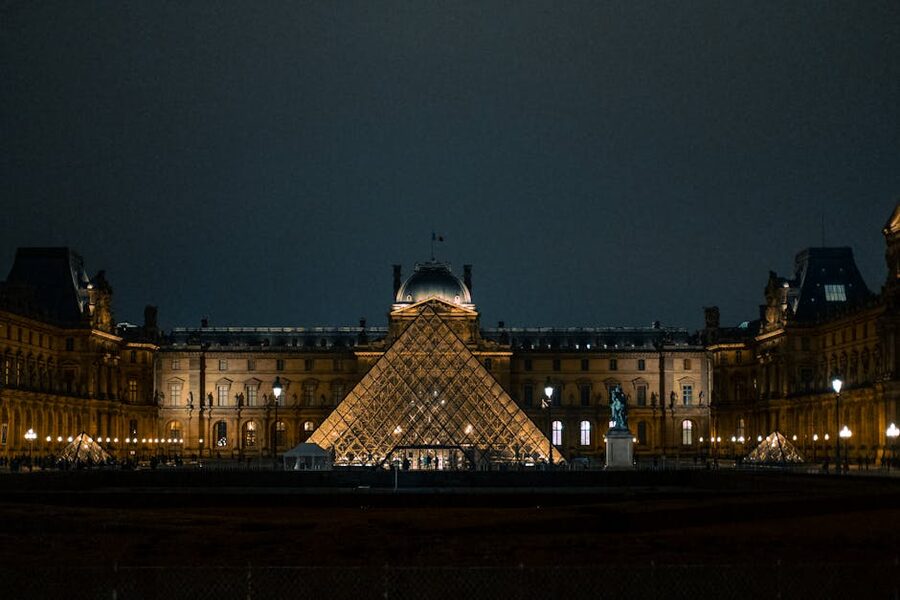
A Louvre ticket is €22 if you live in the EEA, €32 if you don’t, and the museum has worked out that night-time is when its most famous resident is bearable. The Mona Lisa room hits 300 people deep on a midsummer Saturday at noon. On the Wednesday and Friday late openings, when the museum stays out until 9pm, the same room thins to maybe a third of that by 8pm. And on the first Friday of the month from October through June, after 6pm, the entire museum is free. That’s the best fifty euros you don’t spend on a Da Vinci Code trip to Paris, and it’s the single fact this guide is built around.
I read The Da Vinci Code on a Eurostar going the wrong direction in 2005. By the time we hit Lille I was the kind of fan who underlines passages, and by the time I actually got to Paris I’d already made notes about the Salle des États and the gnomon at Saint-Sulpice. Twenty-odd years later the book has sold around 80 million copies, the film with Tom Hanks has been on television about that many times, and Paris has quietly absorbed the trail into its tourist-board calendar. This is what’s worth doing, what to skip, and where the book and the film diverge enough that you’ll feel slightly cheated if you don’t know in advance.
In This Article
- The Louvre is the trail
- Start at the Hall Napoléon under the Pyramid
- The Inverted Pyramid: shorter visit than you think
- Salle des États and the Mona Lisa
- The Madonna of the Rocks and the rest of the Da Vinci room
- The Grande Galerie and Salon Carré
- Hera of Samos and the Arago medallion
- Saint-Sulpice: the most lied-to church in Paris
- The gnomon and the so-called Rose Line
- What’s actually worth looking at inside
- The Ritz, Place Vendôme
- Bois de Boulogne, the night drive
- Château de Villette: the day trip you probably won’t take
- Saint-Lazare and the night-train scene
- The Temple Church side trip (London, not Paris)
- Where to actually stay near the Louvre
- Splurge: Hôtel du Louvre
- Mid-range: Hôtel Thérèse
- Budget: Hôtel Britannique
- The after-hours Louvre tour, if you have the budget
- Practicalities and a quick day plan
- The book is fiction. The walk isn’t.
The Louvre is the trail
Eighty per cent of the Da Vinci Code in Paris happens at the Louvre, and the Louvre takes a full day even if you skip the Egyptian wing. Don’t try to do the Da Vinci Code circuit and “see the Louvre” in three hours. Pick one. If you want the trail, the loop below covers every painting and room Dan Brown puts in the book, plus the bits of the film that diverge enough to be worth knowing about, and runs about ninety minutes if you don’t stop for coffee.
Start at the Hall Napoléon under the Pyramid
Robert Langdon enters the museum through the Pyramid in chapter three. The book then has him directed up to the Grande Galerie. You should walk the same way: in through the Pyramid, down the escalator into Hall Napoléon, then up the Denon wing escalator on the right. Don’t bother trying to count 666 panes of glass on the way down. It’s one of the better pieces of Brown trivia and it’s wrong. There are 673, made up of 603 rhombi and 70 triangles, and the conspiracy story was invented in the mid-1980s by people who hated the I.M. Pei design and wanted Mitterrand to look satanic. Both Pei and Mitterrand are now dead, the Pyramid is unambiguously beloved, and the 666 number still circulates in fan forums because it’s a better story than the truth.
The Inverted Pyramid: shorter visit than you think
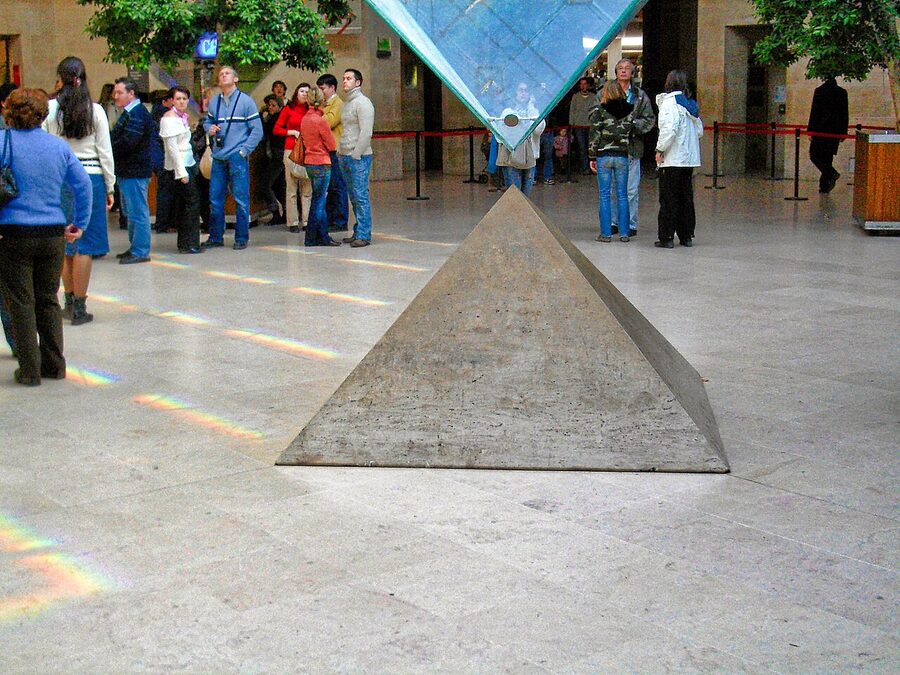
The end-of-novel reveal happens here, where the small stone pyramid below the inverted glass one supposedly marks the resting place of Mary Magdalene. The actual structure is in the Carrousel du Louvre, the underground shopping mall connected to the museum, and you don’t need a Louvre ticket to see it. You don’t even need to enter the museum. There’s a metro entrance from Palais Royal-Musée du Louvre and you can wander in past the Apple store, look at it, take the picture, and leave. Most fans linger here longer than they need to because they expect a moment and it’s a piece of mall architecture with a glass triangle. The moment is in your head from the book; the structure delivers approximately ninety seconds of it.
Salle des États and the Mona Lisa
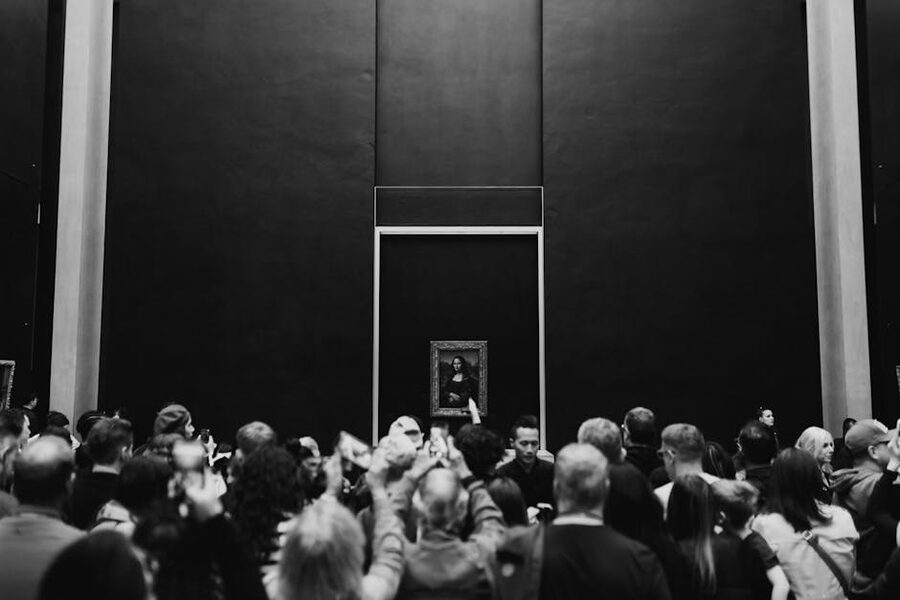
Sophie Neveu and Langdon stand in front of the Mona Lisa in the book, in a closed museum, in dim emergency lighting, with no one else in the room. You will stand in front of her with around 200 of your fellow tourists, behind bulletproof glass, in light that has clearly been designed to flatter her at the expense of your photo. She is also genuinely smaller than you imagine, about 77 by 53cm. The Salle des États is in the Denon wing, room 711 (formerly room 6 in the older numbering many guidebooks still use), and the Louvre has been planning to give her her own dedicated room as part of the Louvre New Renaissance refit. Until that finishes, this is where she lives.
The least painful Mona Lisa visit I’ve had was an 8pm slot on a Friday night opening in November. Six rows deep instead of fourteen. Use that.
The Madonna of the Rocks and the rest of the Da Vinci room
Sophie hides the cryptex behind The Madonna of the Rocks, which is in the same Denon wing on the second floor (room 710 in the new numbering, formerly room 5). The painting is a lot more interesting than the Mona Lisa to look at, the room is almost always quiet because everyone is queueing two doors down, and Brown’s reading of Mary’s hovering hand and the angel Uriel’s slicing gesture has at least one art historian on its side. You can stand a metre away from it for as long as you want.
While you’re in this part of Denon, look for The Virgin and Child with Saint Anne (also Leonardo, also room 710), Noli Me Tangere by Bronzino (room 712, formerly room 8), and Death of the Virgin by Caravaggio (same room). All four come up in the book; all four are within a five-minute walk of each other.
The Grande Galerie and Salon Carré
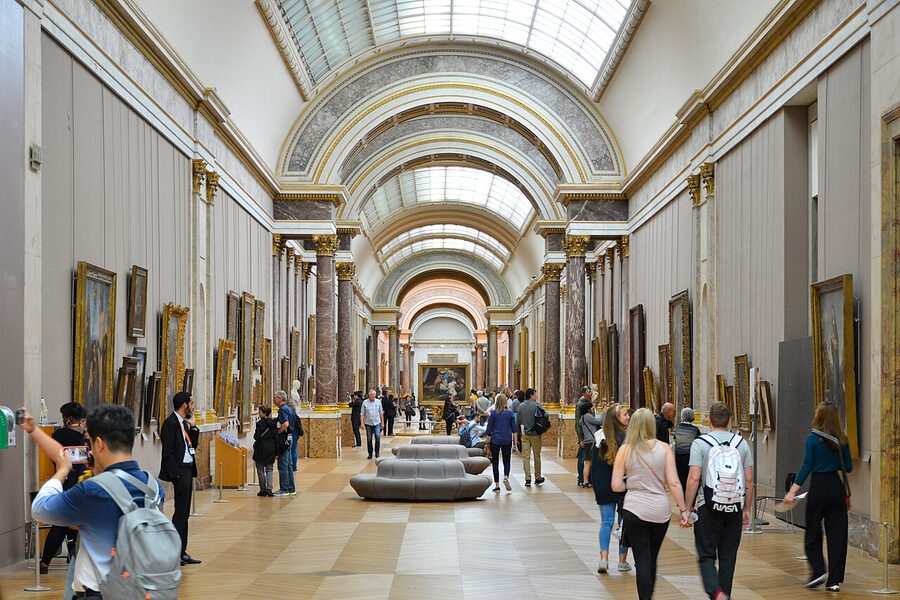
The book opens with Jacques Saunière collapsing in the Grande Galerie. The film tweaks this slightly, putting the body, with its star-shaped marks on the parquet, in the Salon Carré (room 708 in the new numbering), which is where Silas was actually standing when he shot him. There’s no metal gate between the two rooms, no matter what the book says. There are gates between other parts of the museum, just not this one, which Brown collapsed for the sake of a good chase.
The Grande Galerie itself is roughly 460m long, runs along the Seine side of Denon, and has the Italian paintings collection along its full length. Worth walking even if you don’t care about the book.
Hera of Samos and the Arago medallion
Two minor stops on the Da Vinci Code trail that most guides skip. The Kore statue called Hera of Samos lives in the Denon mezzanine, room 1, and Brown hangs his sacred-feminine theme on her. She’s archaic Greek, around 570 BC, and worth a ten-minute detour even if you’re sceptical about Brown’s reading.
The Arago medallion is the start of the actual Paris meridian, what Brown calls the Rose Line, and one of them is set into the floor of the Louvre on the staircase that leads up to the Winged Victory of Samothrace. Look for a small bronze disc with ARAGO and N/S marks. There are 135 of these scattered through the city, an artwork by the Dutch sculptor Jan Dibbets installed in 1994 in honour of the astronomer François Arago. The Saint-Sulpice section below has more on what the meridian actually is and isn’t.
Saint-Sulpice: the most lied-to church in Paris
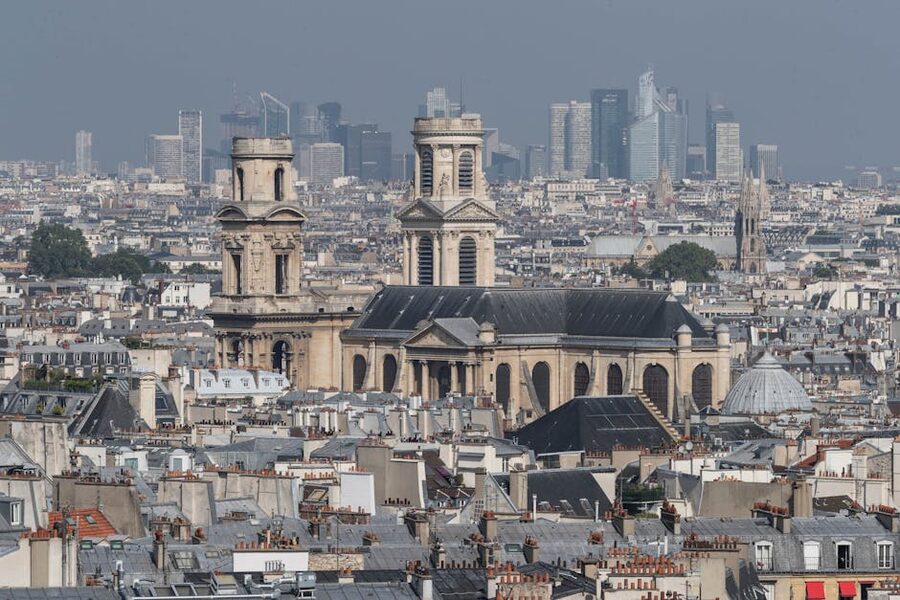
Saint-Sulpice is at 2 Rue Palatine in the 6th, a six-minute walk from Saint-Sulpice metro on line 4, and entry is free. It’s the second-largest church in Paris, after Notre-Dame, and the parish where the Marquis de Sade was christened, which is the kind of detail Dan Brown would have used if he’d known. He didn’t, so we get the gnomon instead.
The thing to know before you go in: the dramatic film scene in which Silas hunts down the keystone happens on a Shepperton Studios soundstage in southeast England. The actual church refused permission to film inside. The exterior is real, the interior in the film is a digital recreation, and there is a small printed notice somewhere near the entrance reminding visitors that the events of the novel are fictional and the church does not contain a buried Priory of Sion artefact. Read the notice. It’s funnier than the book.
The gnomon and the so-called Rose Line
The brass strip running across the floor and up the obelisk in the north transept is real. It was installed in 1743 by Pierre-Charles Le Monnier as a working astronomical instrument to determine the date of Easter. At noon the sun strikes a small hole in the south transept window and the spot of light moves along the brass strip. On the equinoxes it lands on the floor plaque; on the winter solstice it climbs the obelisk. There’s nothing pagan about it, no priory hides anything beneath it, and the Paris meridian (the actual one, the one the Arago medallions trace) runs about 100 metres east of the church. Brown moved the meridian into the church for the plot. He also called it the Rose Line, which nobody else has ever called it; the actual Paris meridian was the prime meridian for France between 1667 and 1884.
The two stained-glass windows with P and S in the rose pattern at the ends of the transepts refer to Peter and Sulpice, the patron saints of the church. They have nothing to do with the Priory of Sion. Brown was at his cleverest here, finding two genuine letters in the stonework that fit a fake organisation perfectly. The verger I asked about it twenty years ago looked tired and explained it for the thousandth time without breaking eye contact.
What’s actually worth looking at inside
The Delacroix murals in the Chapel of the Holy Angels, immediately on your right as you enter, are the real reason to come. Jacob Wrestling with the Angel and Heliodorus Driven from the Temple, painted between 1855 and 1861, his last great commission. He died with the chapel almost finished and the colours have faded a little but the brushwork is exactly what you’ve travelled to Paris to see. Free, ten minutes, almost always empty because everyone is photographing the gnomon.
The organ is one of the largest in France, with around 7,000 pipes, and there are free recitals after the Sunday morning mass at 11.30am. If you’re a Sunday morning person, that’s the visit to plan around.
The Ritz, Place Vendôme
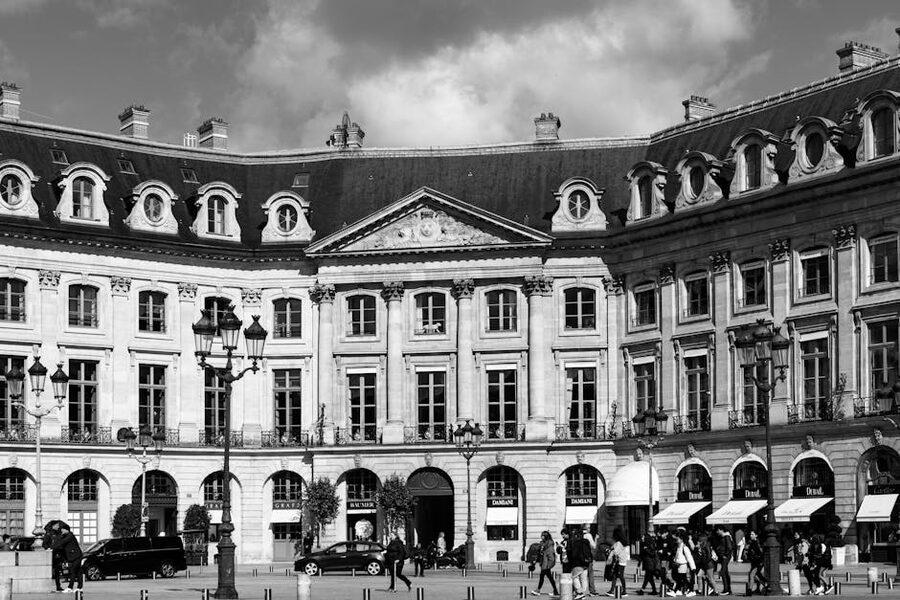
Robert Langdon stays at the Ritz on Place Vendôme. So did Hemingway, Coco Chanel (who lived in suite 302 for over thirty years), and Princess Diana, who had her last meal here on 31 August 1997. Rooms start around €1,800 a night and rise from there. You’re not staying here.
What you can do without selling a kidney is sit at Bar Hemingway, which is genuinely excellent and exactly as small and clubbable as it sounds. Cocktails are around €30 each, including the famous Ritz dry martini, which the writer Colin Field built into a cult product over decades behind the bar. Open from 6pm. Dress code is jacket-required-but-no-one-will-stop-you-if-you-look-tidy. Bar Vendôme at the front of the hotel does an afternoon tea (around €100) and is a softer entry point if cocktails aren’t your thing.
If you can’t quite stretch to either, just walk the square. Place Vendôme is one of the most architecturally consistent in Paris, designed by Jules Hardouin-Mansart in the 1690s, currently home to about thirty jewellery houses (Cartier, Chaumet, Boucheron, Bulgari) and the column in the middle commemorating the Battle of Austerlitz. Free, open, and walking distance from the Louvre via Rue Saint-Honoré.
Bois de Boulogne, the night drive
Langdon and Sophie cut through the Bois de Boulogne on the western edge of Paris while escaping the city. The book makes it sound seedy. By daylight it isn’t. The Bois is around 8.5 square kilometres, was given to the city by Napoleon III in 1852, and contains two lakes, a horse-racing track at Longchamp, and the Fondation Louis Vuitton (the Frank Gehry glass building from 2014, well worth its €16 ticket if you’re into contemporary art).
For the book pilgrim, the relevant detail is that the western tip near Porte Maillot or Porte Dauphine is what Brown is describing. Take metro line 1 to Porte Dauphine, walk in, follow the lake. Do not do this at night, despite what the book does. The reasons are practical (poorly lit) rather than dramatic. By day it’s one of the prettiest urban parks in Europe and almost no one in central Paris bothers with it.
Château de Villette: the day trip you probably won’t take
Sir Leigh Teabing’s house in the book is Château de Villette, a real 17th-century château in Condecourt, around 40km northwest of Paris. The film didn’t shoot here. Burghley House in Lincolnshire stood in for it, but the book absolutely puts the action here, and the château leans into the connection.
It’s not open as a regular tourist attraction. You can stay there (rooms from around €800), book it for events, or join a private Da Vinci Code-themed tour run by the property. Getting there without a car is awkward: SNCF train from Saint-Lazare to Vauréal-Cergy then a 15-minute taxi. Most fans skip it and I’d skip it too, unless you’re a serious enough Brown reader to want to sit in the actual library. If you are, it earns its day.
Saint-Lazare and the night-train scene
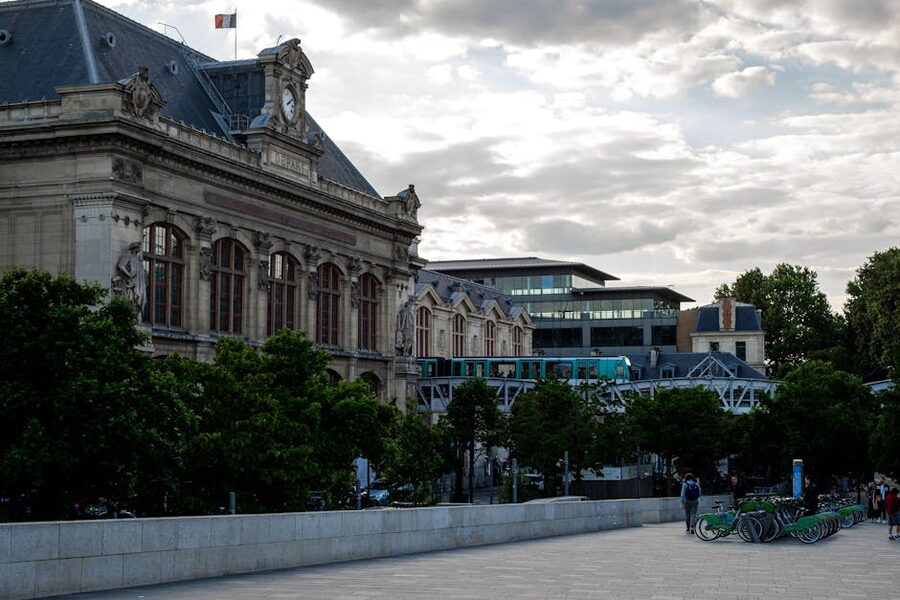
In the book Sophie and Langdon hit Gare Saint-Lazare looking for a train to escape the city, in the kind of late-night scene Brown loves where everything is coordinated against the protagonist. In real Paris in 2026, Saint-Lazare is the second-busiest station in Europe, handles around 450,000 commuters a day, and has an underground shopping centre that’s larger than some Italian towns. There’s no overnight train you’d realistically take from here for the kind of escape the book describes; the night-train network out of Paris mostly leaves from Austerlitz now.
Worth a five-minute look on your way past, if only for the Monet connection. He painted the station eleven times in 1877 and four of those canvases are in the Musée d’Orsay across the river. Otherwise it’s a station, you can grab a coffee, you can move on.
The Temple Church side trip (London, not Paris)
Worth flagging because it confuses people. The Temple Church scene where Langdon, Sophie and Teabing hunt for the knight’s tomb is in London, not Paris. It’s a real 12th-century Templar round church off Fleet Street, EC4Y 7BB, entry £5 for adults, £3 for students, closed on weekends and during legal events. Eurostar from Gare du Nord to St Pancras is around 2h20 and from there it’s a 20-minute walk. If you’re already doing a Paris-London trip and you’ve read the book, slot it in. If you’re staying in Paris only, skip it without guilt; the actual filming of the interior was done at Lincoln Cathedral anyway, and the Temple Church visit pays off mostly as an architectural curiosity rather than a Code revelation.
For more on doing London as a book pilgrim, see our Harry Potter travel guide to London; the same Eurostar trip covers both.
Where to actually stay near the Louvre
If you want the Da Vinci Code trail to be walkable, stay in the 1st arrondissement. The five-minute walk to the Pyramid in the morning, before the day-trippers from the suburbs arrive, is the entire reason to spend a bit more on the hotel.
Splurge: Hôtel du Louvre
Directly across Place du Palais Royal from the Pyramid, in a building Napoleon III commissioned in 1855. Rooms from around €450 in low season, €700+ in summer. The Pissarro suite has the view he painted in 1898. Check rates on Booking.com.
Mid-range: Hôtel Thérèse
A small 43-room hotel on Rue Thérèse, three minutes’ walk from the Palais Royal. Around €250 in shoulder season. Quiet street, decent breakfast, the kind of place where the same person checks you in and explains the metro to you. Check rates on Booking.com.
Budget: Hôtel Britannique
On Avenue Victoria near Châtelet, eight minutes from the Louvre on foot. Around €180 in low season for a small but well-finished double. The breakfast is unremarkable; that’s what the bakery on Rue de Rivoli is for. Check rates on Booking.com.
The after-hours Louvre tour, if you have the budget
The Louvre runs an official evening tour on certain Wednesdays and Fridays after the museum closes to the public, called La Nocturne. Not cheap (around €75 per person, depending on the operator), strictly limited groups, and it’s exactly as theatrical as it sounds. You’ll have the Salon Carré, the Grande Galerie, and the Salle des États genuinely empty. A reader who’s done the trail and wants the closing scene of the book in real life can have it for the price of a decent dinner.
If the official Nocturne is sold out (often is), several private operators run after-hours Louvre access. Browse Da Vinci Code tours on GetYourGuide for the current options. Some of these include the Code itinerary specifically; others are general Louvre night tours that you’d treat as a different kind of evening.
Practicalities and a quick day plan
Two days in Paris is enough to do the trail properly without rushing. One sensible plan:
Day one (Friday): Saint-Sulpice in the morning before mass starts (open 7.30am to 7.30pm, free). Lunch at a café on Rue de Tournon. Walk north over the Seine via the Pont du Carrousel, do the Carrousel du Louvre and the Inverted Pyramid for free in the afternoon. Bar Hemingway at 6.30pm if you’re feeling flush, otherwise walk Place Vendôme. Re-enter the Louvre at 6.30pm for the Friday late opening, do the Denon wing trail until the museum closes at 9pm.
Day two (Saturday): Take metro line 1 to Porte Dauphine and walk into the Bois de Boulogne for an hour. Lunch in the 16th. Afternoon at Musée d’Orsay (the Monet Saint-Lazare paintings) or Musée du quai Branly. Eurostar to London the following morning if you’re doing the Temple Church.
Total ticket cost for a non-EEA visitor doing this properly: around €32 for the Louvre, free for Saint-Sulpice and the Inverted Pyramid, €16 for the Fondation Louis Vuitton if you slot it in, €30 for one cocktail at the Ritz. Under €100 for the entire trail before food.
The book is fiction. The walk isn’t.
The single most useful thing about The Da Vinci Code as a Paris guide is that Dan Brown picked extremely good locations and pinned them to a story that makes you actually pay attention to them. The Louvre rewards a slow visit. Saint-Sulpice is more interesting once you’ve spent twenty minutes thinking about it than it would be if you just walked in. The Ritz earns the cocktail. Even Bois de Boulogne, which Brown writes as a dodgy underbelly, is one of the best urban parks in Europe.
The literary-travel angle is exactly what the rest of this site is about, and the Reading Challenge is the structure I use to plan trips. If the Da Vinci Code trail worked for you, our Under the Tuscan Sun guide to Cortona covers Frances Mayes’s Bramasole and the rest of the small-Tuscan-town circuit. The Talented Mr Ripley guide to Procida picks the small Italian island where Highsmith’s Mongibello scenes were filmed (and which is much better than Capri). For the same trick on the other side of the world, the Crazy Rich Asians guide to Singapore walks the actual visitor city next to Kevin Kwan’s old-money one. And the Read and Travel Challenge Reading and Travel Challenge is the framework: read the book, then go to the place.
I’d do the Friday night opening again tomorrow.