You can visit every Singapore filming location from Crazy Rich Asians in two days for under SGD $100, including a meal at the same hawker centre Nick takes Rachel to. The single thing that catches everyone is the Marina Bay Sands infinity pool, which is hotel-guest only and stays that way no matter how many tour videos suggest a workaround. Pay the SGD $32 SkyPark Observation Deck ticket if you must see the view. Skip the pool entirely and put the SGD $400 a night you saved into a real meal at one of the hawker centres a Singaporean would actually take you to. That, and the rest of this guide, is the trip.
I read the book the year it came out, watched the film twice in a Singapore cinema in 2018 (once with my partner, once with a Singaporean friend who corrected my pronunciation of CHIJMES the entire way through), and went back in 2024 to walk the route again. This guide is what we wish someone had handed us. It’s a city-first travel guide to Singapore, with the Kevin Kwan film as the lens. Standalone enough to use on a regular trip; with enough book and film references to make a fan happy. SGD prices throughout, current for 2026. Skip-rated where things aren’t worth it.
In This Article
- The book vs the film vs the actual city
- Newton Food Centre: the hawker scene, in real life
- Where Singaporeans actually eat: alternatives to Newton
- CHIJMES: the wedding chapel
- Gardens by the Bay: the wedding reception location
- The reception spot, exactly
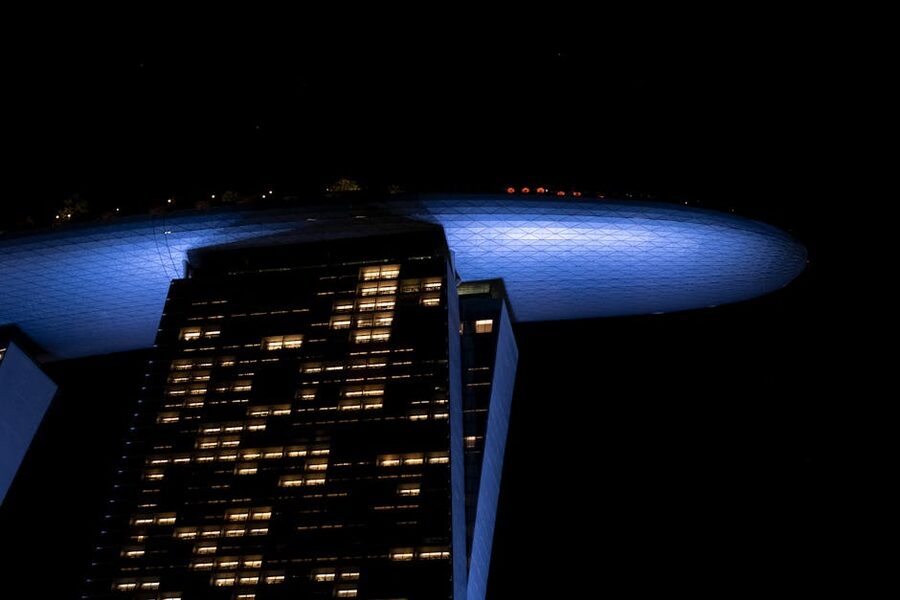
- Marina Bay Sands: the SkyPark scenes (and the pool you can’t visit)
- Bukit Pasoh Road and Ann Siang Hill: the shophouse scenes
- Esplanade Park and Anderson Bridge: the proposal scene
- Tyersall Park, Nassim Road and the Botanic Gardens: the old-money streets
- Where to actually stay
- What to skip
- Getting around: the practical bits
- One thing the book and film both miss
- Reading and re-watching order before the trip
- Two-day route, in order
The book vs the film vs the actual city
The first thing to know if you’re using either as a guide: the book and the film disagree about almost every Singapore location. Kevin Kwan wrote the novel from his own memories of growing up in Singapore in the 1980s and 1990s, and it shows. The book sends Rachel and Nick to Lau Pa Sat for hawker food, holds the wedding at the fictional First Methodist Cathedral, and stages the reception at Fort Canning Park. Director Jon M Chu and his team rebuilt all of that for the screen. They picked Newton Food Centre over Lau Pa Sat because the lighting was better and the centre was less spread out. They moved the wedding to CHIJMES. They moved the reception to Gardens by the Bay’s Supertree Grove because the visual was bigger.
And then there’s the third Singapore: the one you actually visit. About a third of the film’s “Singapore” was shot in Malaysia. The Tyersall Park mansion is the Carcosa Seri Negara estate in Kuala Lumpur. Most of the Mahjong scene interior is the Cheong Fatt Tze mansion in Penang. The wedding bachelor party scenes were shot on Pangkor Laut, an island off the Malaysian coast. None of those are reachable on a Singapore trip and you should skip the tours that promise them. What’s left in Singapore is roughly ten locations, all walkable or one MRT stop from each other, and they make a clean two-day itinerary.
One thing that genuinely stayed the same in all three Singapores: hawker food. The film shot a real hawker centre, the book references real hawker centres, and you should eat at three or four of them while you’re here. More on that below.
Newton Food Centre: the hawker scene, in real life
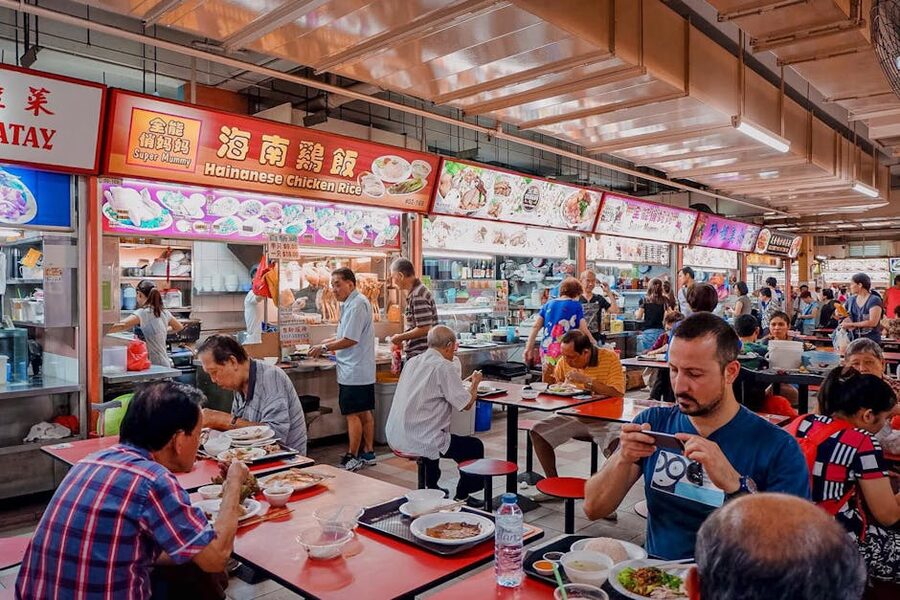
Newton Food Centre is the hawker scene. The whole one. Where Colin and Araminta take Nick and Rachel for satay, char kway teow, chilli crab and “the best Hokkien mee in Asia.” The director’s team picked Newton over the book’s Lau Pa Sat because Newton has better natural lighting and a more compact footprint, and because Kevin Kwan’s own family used to eat there. They closed the entire centre for the shoot, brought in extras for every background table, and built fake satay stalls outside because the director Jon M Chu wanted the outdoor satay grills he’d seen at the East Coast Lagoon hawker centre. So a few of the stalls in the film are not actually Newton stalls. The food is real, though.
Practical:
- Open until 2am daily, but most hawker stalls only run dinner service from around 5pm. A few breakfast stalls open at 6am. Lunch is hit-or-miss. The right time to come is between 6pm and 10pm.
- How to find it: 500 Clemenceau Avenue North, three minutes’ walk from Newton MRT station (NS21 / DT11). Exit B from the platform, follow the covered walkway.
- What to order: the satay at TKR (10 sticks for around SGD $10), the carrot cake and oyster omelette at Heng, and Hup Kee for fried oyster omelette. Chilli crab is the splurge order if you’re with at least two other people and have SGD $80 going spare.
- The chope thing: Singaporeans reserve seats by leaving a packet of tissues on the table. If you see tissues, the seat is taken. If you don’t, you can sit down before ordering. This is Singaporean and unspoken.
- The aggressive front-stall touts: Newton’s front-row seafood stalls have a reputation for hard-selling tourists into expensive set menus. Walk past the touts to the inner stalls. The food is the same and a third of the price.
Where Singaporeans actually eat: alternatives to Newton
An aside. Newton is a good hawker centre but it’s also the tourist hawker centre. If you want one Singaporeans actually pick on a Saturday night, here are three to consider as your second hawker visit:
- Maxwell Food Centre in Chinatown. Tian Tian Hainanese Chicken Rice was Anthony Bourdain’s pick and is still the queue you’ll wait twenty minutes for; the rice plate is SGD $5.50. Maxwell shuts much earlier than Newton, so make it lunch.
- Old Airport Road Food Centre in Mountbatten. The locals’ choice. No film cameo, no obvious tourist crowd, an embarrassing depth of stalls. Get the carrot cake at Heng Carrot Cake (SGD $4) and the lor mee at Xin Mei Xiang (SGD $4.50).
- Lau Pa Sat, the centre the book actually picks. The 1894 Victorian octagonal market in the financial district. Worth visiting even for the building alone. The satay street outside, Boon Tat Street, closes to traffic at 7pm and turns into an open-air satay restaurant; that’s the move at night.
If you do all three plus Newton, you’ve eaten better than Nick Young.
CHIJMES: the wedding chapel
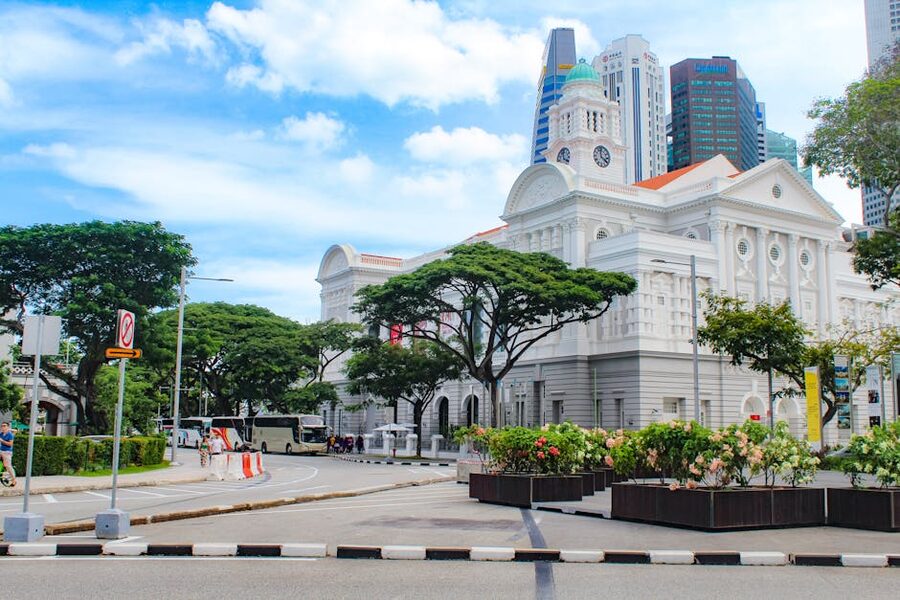
Where Colin and Araminta have their wedding, with the water-flooded aisle and the orchestra and the unbroken twelve-minute crane shot. CHIJMES (rhymes with chimes) was the Convent of the Holy Infant Jesus from 1854 until 1983. After the convent and girls’ school moved out, the colonial complex was restored in the 1990s as a dining and events venue. The chapel that hosts the wedding scene is now a function hall. You can rent it for an actual wedding for around SGD $20,000 and up, which is steep until you remember that fictional Colin Khoo’s reception bill ran to seven figures.
What’s there to see if you’re not getting married:
- The CHIJMES Hall exterior. The Gothic-style chapel facade is the postcard shot and is exactly as it appears in the film. Best photographed at dusk when the spotlights come on. The aisle of water and the foliage are movie-only additions; on a normal day the inside is a flat hardwood event floor.
- The compound itself. A wraparound colonial complex with a courtyard, a fountain area, and around twenty restaurants and bars at ground level. Free to walk through.
- Drink at Lemuel Chocolate Bar if you want a cocktail with a chapel view. They’ve leaned into the photogenic setting and the rooftop tables face directly across at the Hall.
Thirty minutes is enough unless you want to eat. The chapel without its movie dressing is much less impressive than the trailer suggests, and the rest of the compound is essentially a nightlife arcade. CHIJMES is right next to Raffles City Mall and the Bras Basah arts district, so it sits well as a five-minute stop on a longer Civic District walk rather than a destination of its own.
Address: 30 Victoria Street. Two minutes from City Hall MRT (NS25 / EW13), exit A. Open 24/7 as a public space; restaurants run roughly noon to midnight.
Gardens by the Bay: the wedding reception location
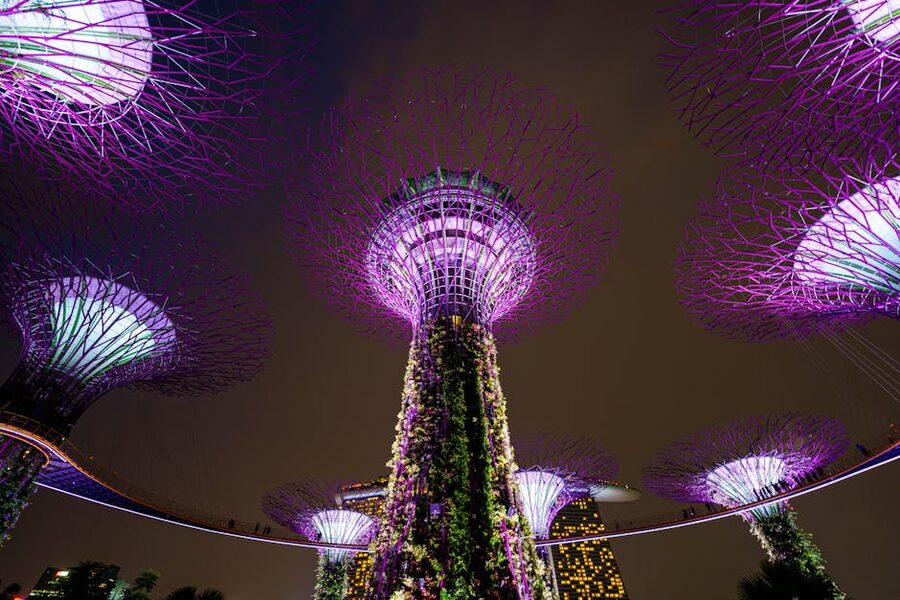
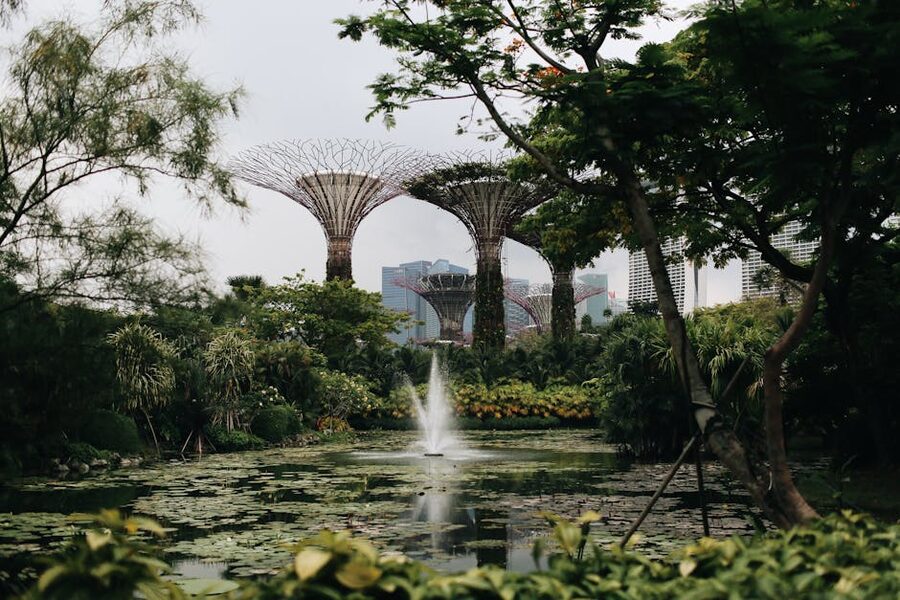
The wedding reception in the film is held under the Supertree Grove with the synthetic alien trees lit up and a string quartet on a floating stage. In the book, the reception is at Fort Canning Park. The film moved it because the Supertrees are the most photographed thing in Singapore and the producers knew it. Of all the Crazy Rich Asians film locations, this is the one that genuinely lives up to its trailer shot.
What it costs to do this properly:
- Supertree Grove walk: free. The grove itself is open and you can walk the ground-level paths around it any time. Most people don’t realise this, and assume the whole gardens cost money.
- Garden Rhapsody light show: free. Daily at 7:45pm and 8:45pm. The 7:45 show is the busier one. The 8:45 show is calmer and lit slightly differently.
- OCBC Skywalk: SGD $14 adult, SGD $10 child. The 22-metre canopy bridge between the Supertrees. Worth it for one of the two light shows; not worth a daytime visit unless you’re dropping in anyway.
- Cloud Forest dome: SGD $20 adult, SGD $14 child. A misted indoor mountain with a 35-metre indoor waterfall and a series of looped walkways climbing to the top and looping back down. Genuinely impressive, even if you don’t care about plants. Strongest non-film draw at Gardens by the Bay.
- Flower Dome: SGD $20 adult, SGD $14 child. Skip unless you’re a botanic-garden person. The flower changes are seasonal. Combination ticket with Cloud Forest is SGD $32 adult, which is the right play if you’re doing both.
- Supertree Observatory: SGD $14 adult. The observation deck on top of the tallest Supertree, 50 metres up. Better view than the Skywalk and closer to the reception scene angle.
- Combo Klook tickets for Cloud Forest, Flower Dome, OCBC Skywalk and Supertree Observatory run about SGD $50 and skip the on-site queues; that’s the right call if you’re doing all four.
The right rhythm: arrive at Gardens by the Bay around 5pm, walk the Supertree Grove, do Cloud Forest before the light starts dropping, eat at one of the on-site restaurants in Bay East Garden (Pollen is the upscale option; Satay by the Bay the casual one), then time your way to the Supertrees for the 7:45 show on the ground and the 8:45 show on the Skywalk.
The reception spot, exactly
For film fans: the actual reception scene was filmed in the central clearing under the Supertree Grove canopy, between the four largest trees, looking south toward Marina Bay Sands. The bride and groom’s table positioning faces the Supertrees themselves. You can stand on that exact spot any night during Garden Rhapsody, look up, and reproduce the camera angle. The Chinese characters that hung from the canopy in the film were Qiu (邱, Khoo) and Li (李, Leong) and the surnames of the fictional couple. They aren’t there now.
Address: 18 Marina Gardens Drive. Two minutes from Bayfront MRT (CE1 / DT16), exit B (follow signs to Gardens by the Bay).
Marina Bay Sands: the SkyPark scenes (and the pool you can’t visit)
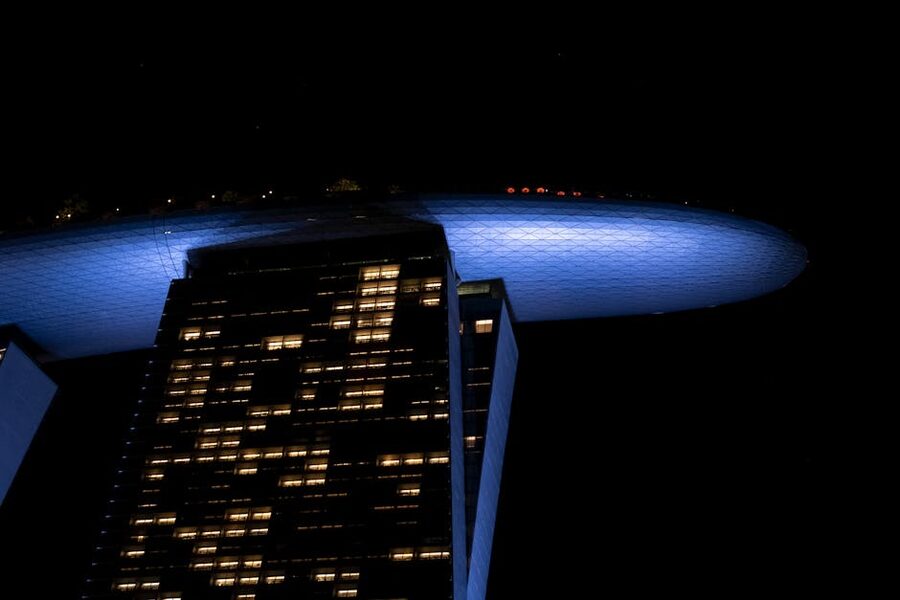
Marina Bay Sands appears as a backdrop in roughly half the film and as a featured location twice. The Radio1Asia gossip scene at the start is set in the SkyPark restaurants, and Nick and Rachel’s engagement party at the end is at Cé La Vi nightclub on the roof, with the synchronised swimmers in the infinity pool below.
What you can and cannot do, in order of usefulness:
- The infinity pool: closed to non-guests. No exceptions. Hotel security has been tight on this since the film came out. The lift to the pool deck requires the room key card and there are staff at the entrance. If you want to swim in this pool you have to book a room at Marina Bay Sands; rates start around SGD $700 a night for a basic Deluxe and climb fast.
- SkyPark Observation Deck: SGD $32 adult, SGD $28 child. Same building, different deck. You go up to the 57th floor, get a panoramic view of Marina Bay and the financial district, and come back down. Open daily, 11am to 9pm. The pool is not visible from this deck.
- Cé La Vi: still open. Two parts: the rooftop restaurant on level 57 and the SkyBar one floor up. There’s a SGD $20 cover charge that becomes a drink credit. From Cé La Vi you can see the infinity pool through the glass partition without using it. Cocktails run SGD $24 to $32, food is overpriced for what it is. Worth the one drink for the angle.
- Spago by Wolfgang Puck: the other SkyPark restaurant, also at level 57. Drinks are similar money, the dining room is calmer than Cé La Vi and the views slightly better.
- Booking a room at Marina Bay Sands: the only legitimate way to swim in the pool. If you can absorb the rate for one night and want the experience, this is the call. Ask for a Bay-facing room over a city-facing one; the bay view is the postcard.
The SGD $32 observation deck is the standard tourist play and it’s fine. Cé La Vi for one drink is the more interesting move. The pool is only worth booking the hotel for if it’s a one-shot bucket-list thing for you. Most Singaporeans I know have never been in it.
Bukit Pasoh Road and Ann Siang Hill: the shophouse scenes
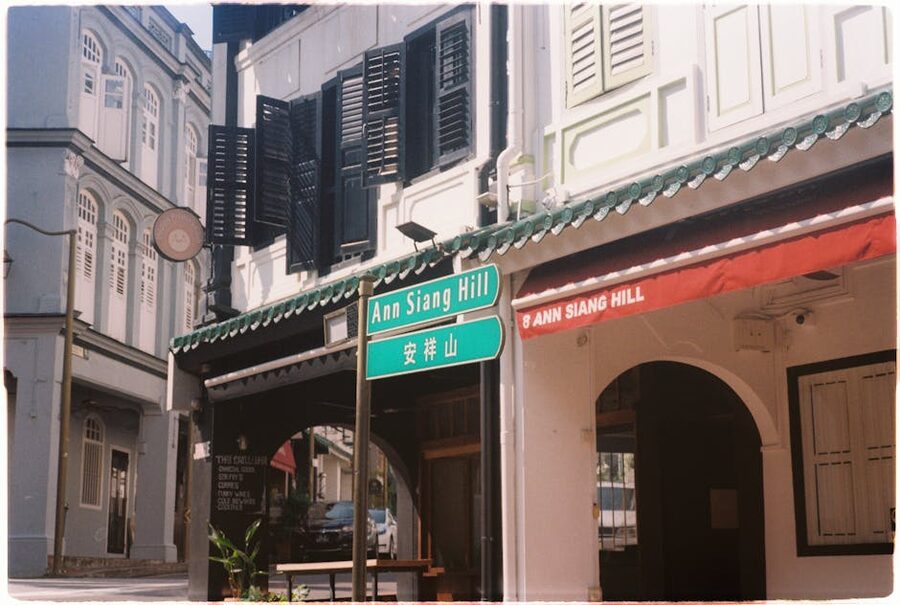
Two adjacent Chinatown streets carry the shophouse-row scenes. Bukit Pasoh Road is where Rachel sits with Peik Lin at the alfresco restaurant Humpback and reports back on the “bawk bawk bitch” confrontation with Eleanor. Ann Siang Hill is where Eleanor walks past the painted shophouses in her white striped suit before entering the mahjong parlour. Both streets are walkable from each other in five minutes; both are restored colonial shophouse rows now lined with bars, cocktail dens and small restaurants.
Two ways to do this neighbourhood:
- Daytime walk (free, 30 minutes): Start at Maxwell Food Centre on the corner of Maxwell and South Bridge Road. Walk up Ann Siang Road, turning into Ann Siang Hill, then loop back via Club Street to Cross Street. Cut over to Bukit Pasoh Road via Keong Saik Road. The whole loop is under a kilometre and covers all the shophouse-row angles you saw in the film.
- Evening drinks (SGD $30 to $60 per round): Start at Operation Dagger (basement on Ann Siang Hill, closed indoor cocktail bar with no signage), walk over to Native (Amoy Street, SE Asian-foraged cocktails), end at Humpback on Bukit Pasoh for seafood and the actual film table. Humpback’s “bawk bawk bitch” patio is the alfresco area on the right side of the building as you face it; the Gan Clan association still occupies the upper floor.
Things to know about Humpback specifically: it’s a small natural-wine and seafood spot, not a fine-dining destination. Their oysters are the draw (SGD $6 to $8 each, six varieties most nights) and they do a strong banana cake for dessert. Reservations are smart on weekends; they take walk-ins midweek. The patio table from the film is unnamed but normally the second outdoor table from the door, on the right.
For the right kind of fan: the Pinnacle@Duxton public housing block sits a three-minute walk from Bukit Pasoh and has a roof garden you can visit for SGD $6. Highest public housing block in Singapore, with a 50th-floor open-air walkway between the seven towers. Buy a token from the security guard at the lobby; the view is the whole financial district and the bay.
Esplanade Park and Anderson Bridge: the proposal scene
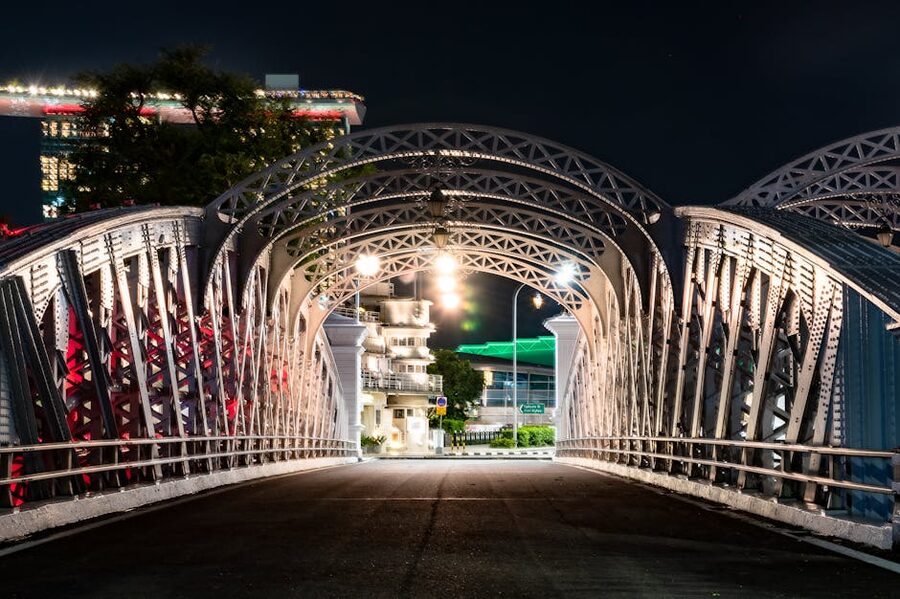
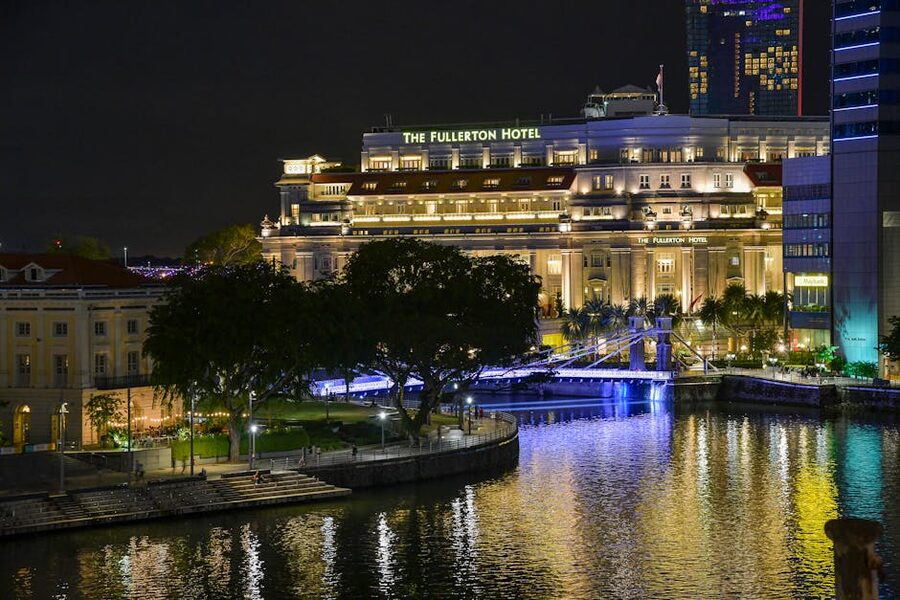
Where Nick proposes to Rachel for the first time and gets turned down. The shot is staged at Queen Elizabeth Walk on the Esplanade Park waterfront, looking out across Anderson Bridge with the Fullerton Hotel and the financial district behind. It’s a free public park and one of the older parts of the Civic District, opened in 1943 with three war memorials including the Lim Bo Seng Memorial that anchors the proposal frame.
What’s worth doing in this stretch:
- Walk the full Civic District loop. Start at the Merlion (free, ten-minute photo stop), cross the Esplanade Bridge, walk the Esplanade Outdoor Theatre Stage (free amphitheatre with the best Marina Bay Sands view in the city), through Esplanade Park past the Lim Bo Seng Memorial, over Anderson Bridge to the Fullerton Hotel, and end at Boat Quay for a riverside drink. Two hours at a wandering pace.
- The National Gallery sits two minutes from the park and is the largest collection of modern Singaporean and Southeast Asian art in the region. SGD $20 adult, free for children under 6. The rooftop bar Smoke and Mirrors has a strong cocktail list and the second-best view of the Padang in the city.
- Cricket Club view: the colonial Singapore Cricket Club faces the Padang green. You can’t go in (members only) but you can walk around the field. In the book, this is the model for the fictional Churchill Club where Astrid’s husband Michael grew up playing football.
The Esplanade Park stretch genuinely is one of the more underrated walks in central Singapore. Most tour groups skip from the Merlion to Marina Bay Sands and miss the older park entirely.
Tyersall Park, Nassim Road and the Botanic Gardens: the old-money streets
The book makes a great deal of Tyersall Park, the imaginary fifty-acre estate where Nick’s grandmother Su Yi lives, hidden behind a forested wall in the middle of the city. Tyersall Park does not exist as a property. There is a Tyersall Avenue, however, running along the south edge of the Singapore Botanic Gardens, and Kevin Kwan has said in interviews that the fictional estate was inspired by the bungalows along this stretch. For the film, the estate exteriors were shot at Carcosa Seri Negara in Kuala Lumpur, not in Singapore at all. So the closest thing you’ll get to Tyersall Park in Singapore is a walk along the Botanic Gardens’ Tyersall Gate side, looking through the fence at the older landed properties.
The two streets that genuinely matter for old-money Singapore:
- Nassim Road: known locally as “Embassy Row.” A loop of large landed houses behind walls, several embassies, and the rumoured most expensive residential street in Singapore. Houses here transact in the SGD $50 to $100 million range. You can walk it freely; it’s a public road. The walk is a quiet one and only really interesting if you’ve read the book and can place the Astrid storyline against the colonial bungalows.
- Cluny Park Road: a tighter cluster of black-and-white colonial bungalows just east of Nassim. The “Goh mansion” exterior in the film (where Peik Lin’s family lives, with the gold trim) was shot on Cluny Park Road. The actual house on the market for sale at one point with no gold modifications.
The right way to do this walk:
Take the MRT to Botanic Gardens station (CC19 / DT9). Spend an hour in the Botanic Gardens itself; it’s a UNESCO World Heritage Site, free, and one of the better tropical gardens in the world. Exit at the Tanglin Gate to the south, walk Cluny Park Road, then loop down Nassim Road. End at the Orchard Road MRT station, which puts you on the city’s main shopping street.
This is a slow flat walk and the appeal is entirely book-context. If you haven’t read the novel, skip it and spend the morning on something else. If you have, it’s a quiet hour in a part of the city the film never really shows.
Where to actually stay
Four hotels, three real-world locations from the film and one practical pick:
- Raffles Hotel is where Nick and Rachel stay in the film, in the Presidential Suite. The hotel reopened in 2019 after a full restoration; rooms now run from SGD $1,200 a night for a Courtyard Suite to about SGD $20,000 for the Presidential. If you want to feel the Crazy Rich Asians budget pinch directly, book the cheapest courtyard suite for one night; you still get the full colonial complex and the Long Bar. Otherwise, skip the room and just go for the SGD $43 Singapore Sling at the Long Bar (you’ll get peanuts; the floor is famously littered with peanut shells).
- Marina Bay Sands is the only way to get into the infinity pool. Deluxe rooms start around SGD $700 a night and climb steeply on weekends. The view-up pricing premium is real; insist on a Bay-facing room. One night only is fine; two nights is excessive.
- The Fullerton Hotel sits directly across the Singapore River from Anderson Bridge and is the building Nick and Rachel walk past in the proposal scene. The hotel is a 1928 former General Post Office, beautifully restored, with the financial district one bridge away and Marina Bay Sands across the water. Rooms run SGD $400 to $600. The best practical Crazy Rich Asians-themed pick if you want a hotel with the right view from the room.
- Ann Siang House for the smaller, more interesting stay. A 20-room boutique conversion of three Ann Siang Road shophouses, on the actual street where Eleanor walked. Rooms from SGD $400. The Chinatown location puts you walking distance from Maxwell Food Centre, Bukit Pasoh, Club Street and the MRT to anywhere else. This is what we’d book.
If you’re on a tighter budget, the simpler call is Lloyd’s Inn in Newton, three minutes from the food centre. Rooms from SGD $250, no film connection but a good pool, central location and the easiest walk to dinner of any hotel on this list.
What to skip
A few things tour operators and competing guides push that genuinely aren’t worth the time:
- The “Crazy Rich Asians filming tour” buses. Most cover the same six sites you can do yourself on foot in two days, charge SGD $80 to $150 per person, and pad the route with a Sentosa stop or two. The Viator Crazy Rich Asians private food tour is the exception (small group, real food, decent reviews); the bus tours are not.
- The Cheong Fatt Tze mansion in Penang as a Singapore extension. Yes, the mahjong parlour interior is shot there. Penang is a separate trip, four hours by air from Singapore. Don’t try to bolt it on for one scene.
- Sentosa Cove for the bachelorette beach scenes. Sentosa Island is mostly Universal Studios and a man-made beach. The bachelorette in the film was shot on Pangkor Laut in Malaysia. Sentosa is fine for kids but it’s not part of this trip.
- The infinity pool sneak. Don’t try. It’s been blocked for years and hotel security will eject you. Book the room or skip the pool.
- The Marina Bay Sands shopping centre. If you want luxury malls, ION Orchard on Orchard Road is a better one. The MBS Shoppes is essentially the same brand line-up with worse air conditioning and a canal you can ride a SGD $25 sampan on, which is exactly as silly as it sounds.
Getting around: the practical bits
Singapore is small and the MRT covers everything in this guide. The film locations are all within five MRT stations of each other.
- Airport to centre: the MRT East-West Line from Changi Airport runs every 12 minutes from 5:30am to midnight. SGD $2.50 to City Hall. The taxi is roughly SGD $25 to $35 day, SGD $35 to $45 late night with surcharges. Grab is SGD $20 to $28 day. Use the MRT unless you have a lot of luggage.
- Day pass: the Singapore Tourist Pass is SGD $17 for one day, SGD $24 for two, SGD $29 for three, with unlimited MRT and bus rides. Almost always cheaper than buying singles, except for short stays of one or two trips a day. Available at TransitLink offices in Changi, Bayfront and several other stations.
- Tap to pay: contactless cards (Visa, Mastercard, AMEX) work directly on the MRT gates. Tap in, tap out, no top-up needed. This is the simplest option for a short trip.
- Best months: February to April. December to January is monsoon season (warm rain in heavy bursts; carry an umbrella all the time). June to September is hot, humid and dry. Singapore is hot year-round, but the air is more bearable in the dry months.
- Tap water is fine, despite what some hotel concierges suggest. Refill at any tap. The bottled-water tax across a five-day trip adds up.
- Plug type: UK three-pin (Type G). Bring an adaptor if you’re coming from the US, EU, Australia or Japan.
One thing the book and film both miss
Both versions of Crazy Rich Asians spend almost no time on the parts of Singapore where 80 percent of Singaporeans actually live. The HDB flats. The Housing Development Board apartments are a Singapore-specific thing: they’re public housing in name, but they’re owned outright by their residents on long leases, and they cover most of the country’s residential land. Nine in ten Singaporeans live in one. They’re large, well-maintained, and a key piece of how Singapore actually works as a country.
If you want to see one and you’re already in the area, two neighbourhoods are worth the detour: Tiong Bahru, a 1930s low-rise estate near Outram Park MRT that has aged into Singapore’s most photogenic walkable old neighbourhood, with independent bookshops, third-wave coffee bars and small bakeries; and Joo Chiat, the former Eurasian quarter east of the centre, with rows of two-storey Peranakan shophouses painted in pastel and a strong food street on East Coast Road. Neither is a film location and that’s the point. They’re the Singapore the Youngs would never have written into the book and the version a regular visitor will probably remember most.
Reading and re-watching order before the trip
The Kevin Kwan books are a trilogy. You only need the first one for this guide, but if you’re packing for the flight:
- Crazy Rich Asians (2013): the original. Sets up Rachel and Nick, the Young family and Singapore. Reads like a beach novel and goes fast. About 12 hours of reading on a long-haul flight. This is the one you want for the trip.
- China Rich Girlfriend (2015): book two, mostly in Shanghai and Hong Kong with the cast you know. Lighter on Singapore but extends Astrid’s storyline into the part of the trilogy most fans actually remember.
- Rich People Problems (2017): book three, back to Singapore around the death of the Young matriarch. The most emotionally textured of the three; reads as the goodbye to Tyersall Park.
For the film: just rewatch the original 2018 movie. The sequels (China Rich Girlfriend was greenlit in 2019, then delayed several times) have not been released as of 2026; the second is reportedly in production again.
If you’re a reader-traveller and this kind of trip is your thing, our Harry Potter travel guide to London covers the same do-the-book-then-go-to-the-place rhythm for an English destination, and A Da Vinci Code travel guide to Paris, Under the Tuscan Sun: a travel guide to Cortona and The Talented Mr Ripley: a travel guide to Procida round out the European reading-and-travel run from this batch. The full lineup lives at the the Read and Travel Challenge Reading and Travel Challenge hub.
Two-day route, in order
To pull the whole guide together:
Day one (the Civic and Bayfront route):
- 9am: Singapore Botanic Gardens, ninety minutes around the lake and the Bandstand
- 11am: walk Cluny Park Road and Nassim Road for the old-money context
- 1pm: lunch at Maxwell Food Centre in Chinatown; Tian Tian Hainanese chicken rice and Liao Fan soya chicken
- 3pm: walk Bukit Pasoh Road to Ann Siang Hill and the shophouse loop
- 5pm: take the MRT one stop to City Hall, walk through CHIJMES, on through the Civic District (Esplanade Park, Anderson Bridge, Merlion)
- 7pm: dinner at one of the riverside spots on Boat Quay or Clarke Quay
- 9pm: drink at the Long Bar at Raffles for a Singapore Sling
Day two (the Marina Bay and Newton route):
- 9am: SkyPark Observation Deck or sleep in if you skipped the pool
- 11am: ArtScience Museum (currently showing the teamLab exhibition; SGD $25)
- 1pm: lunch at the food court in Marina Bay Sands or walk to Lau Pa Sat in the financial district
- 3pm: ferry across to Sentosa for an afternoon, OR National Gallery if you’d rather stay on the mainland (SGD $20)
- 5pm: arrive at Gardens by the Bay; do Cloud Forest before sunset
- 6:30pm: dinner at Satay by the Bay, the on-site casual hawker option
- 7:45pm: Garden Rhapsody at Supertree Grove (ground level)
- 8:30pm: walk up to OCBC Skywalk for the 8:45pm second show
- 9:30pm: dessert and a drink at Newton Food Centre, the original hawker scene
Two days, all the major film and book locations. The whole walk works on Singapore’s MRT, costs roughly SGD $30 to $40 in transit and admissions if you skip the SkyPark and Cloud Forest, or about SGD $90 to $110 if you do them. The chilli crab dinner is extra and worth it.
Kevin Kwan was born in Singapore in 1973 and left for Houston with his family at eleven. He published the novel in 2013, partly from memory and partly from a year of return visits researching what had changed. Most of what he wrote about is still here. The hawker centres are still loud and cheap. The Long Bar still serves Singapore Slings and still pretends the peanut shells on the floor are charming. The Supertrees still light up at 7:45 and 8:45. The Marina Bay Sands pool is still closed to non-guests and the synchronised swimmers are still imaginary. The wedding chapel still doesn’t have a flooded aisle. Bring a hat and a contactless card and have the satay.